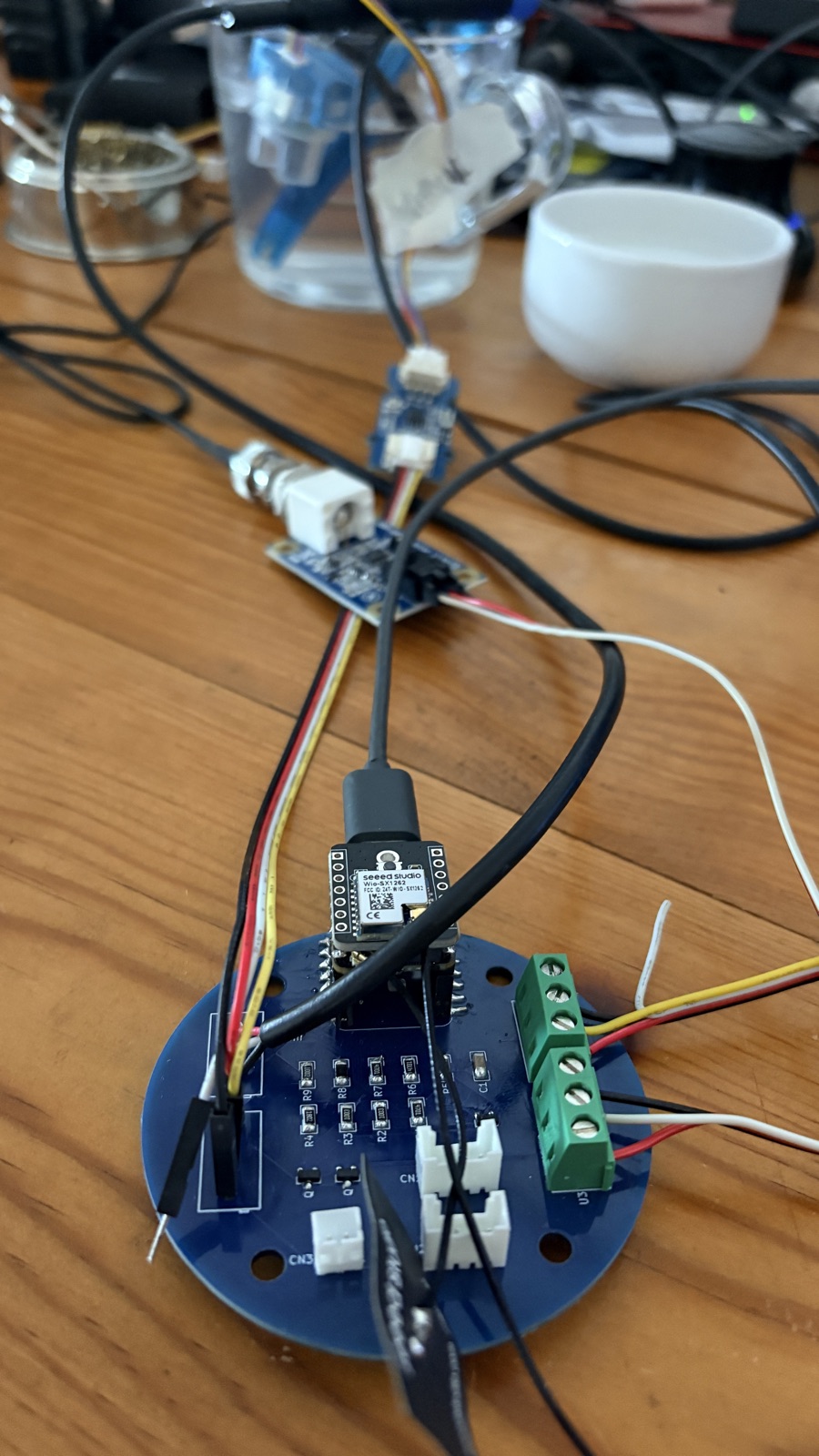
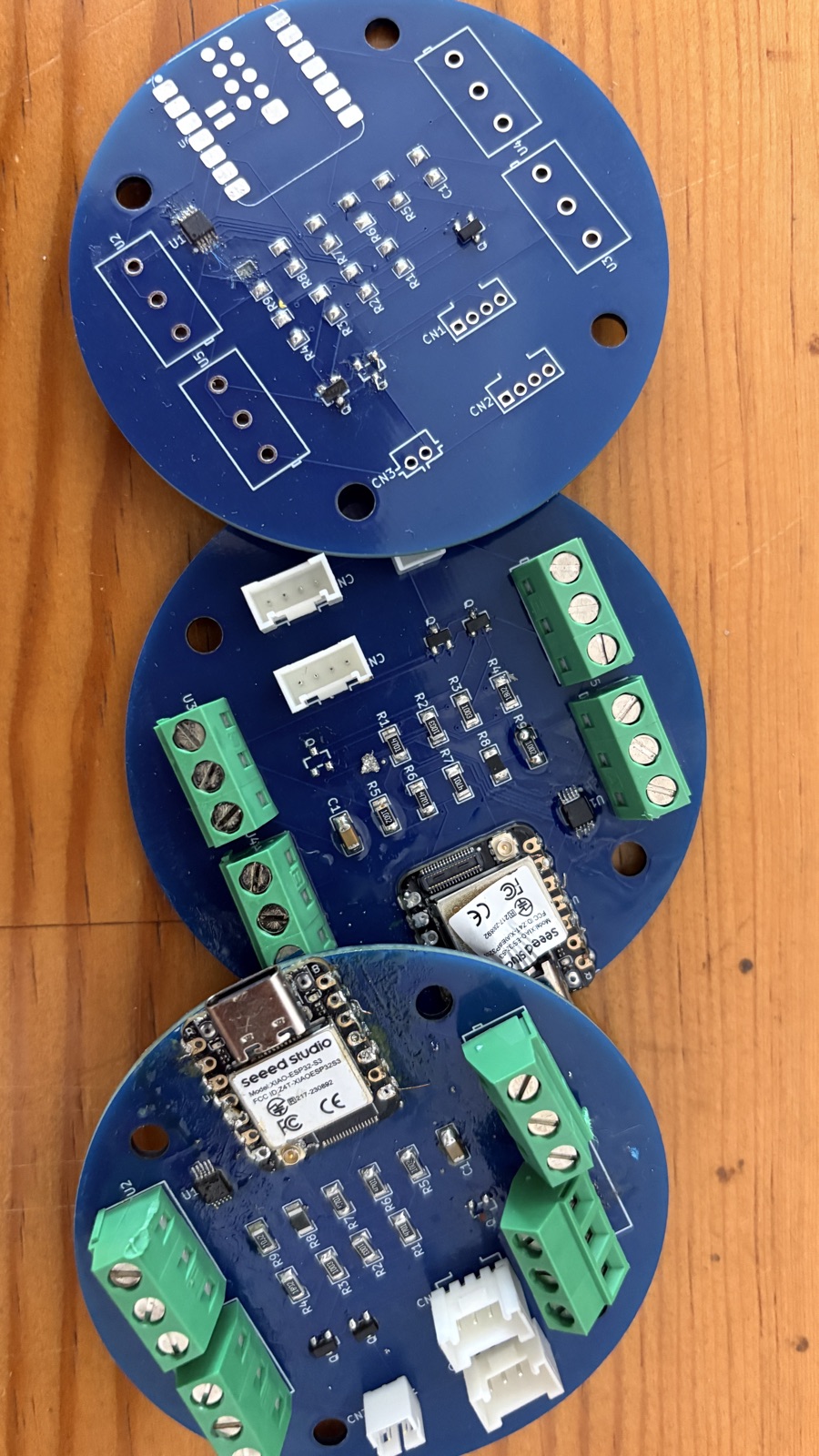
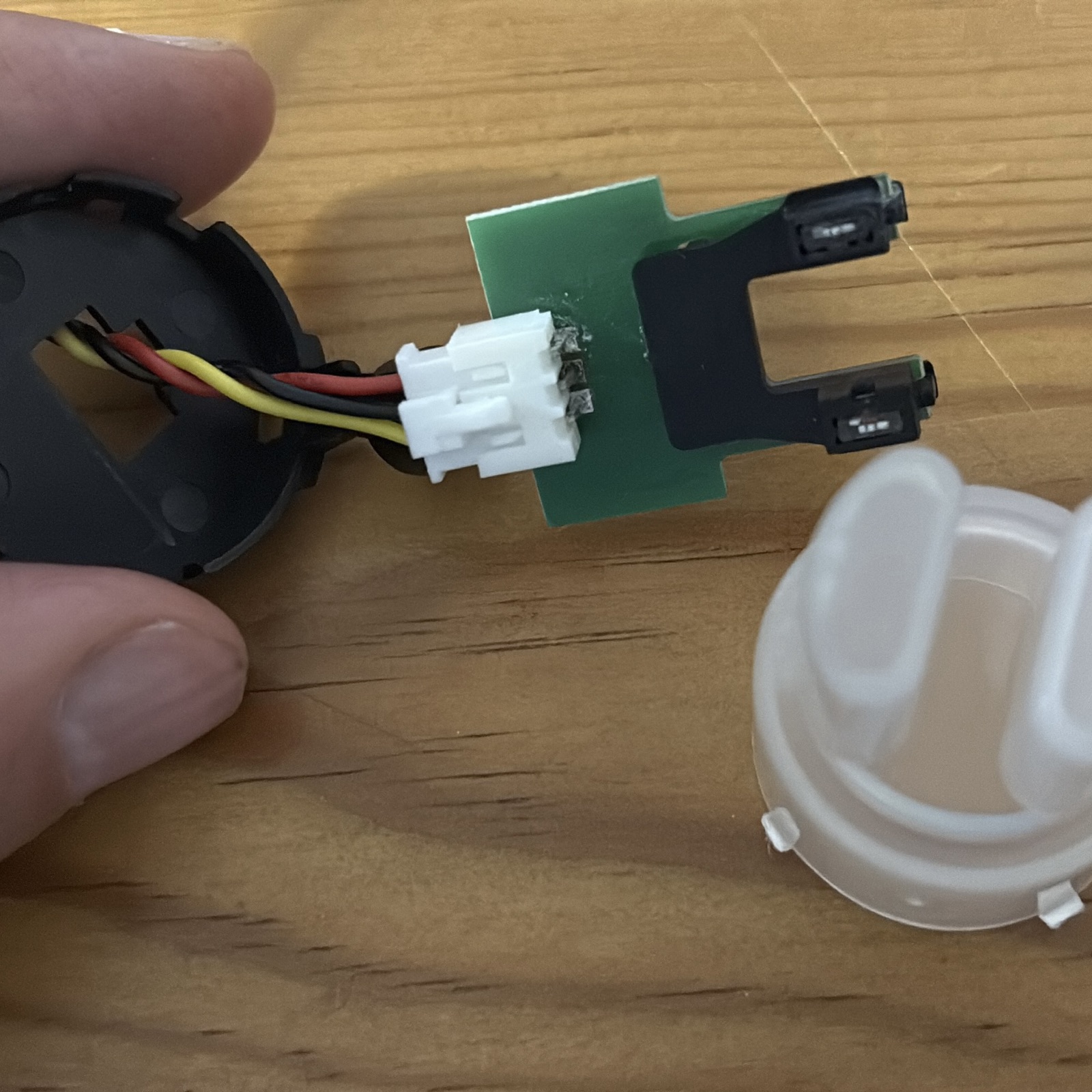
WellBouy — well-water quality node
An open reference design for monitoring a water source over LoRaWAN — temperature, dissolved solids, turbidity and pH. All four sensors are calibrated and validated, the node deep-sleeps and streams to a live dashboard, and the dedicated board is fabricated.
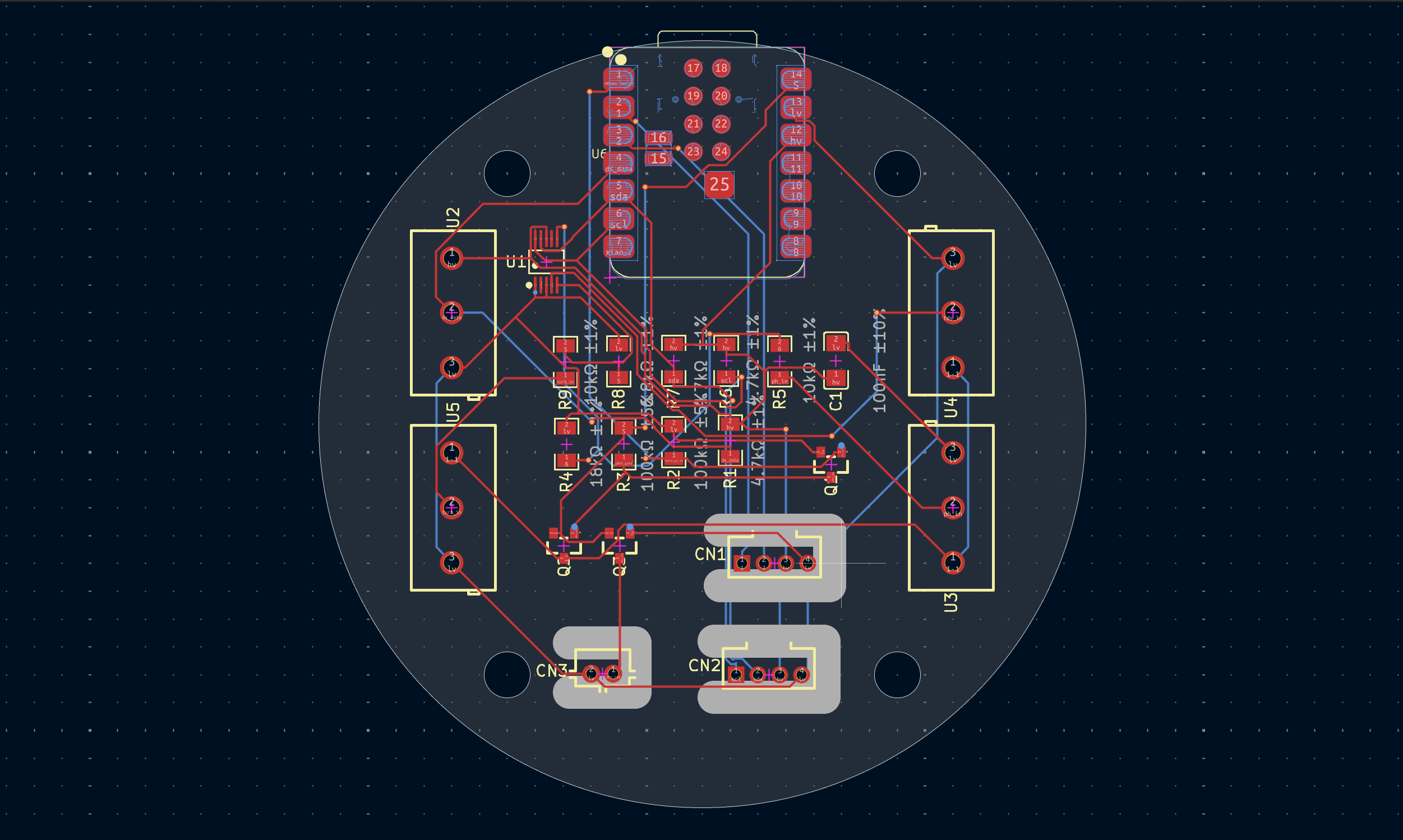
What it is
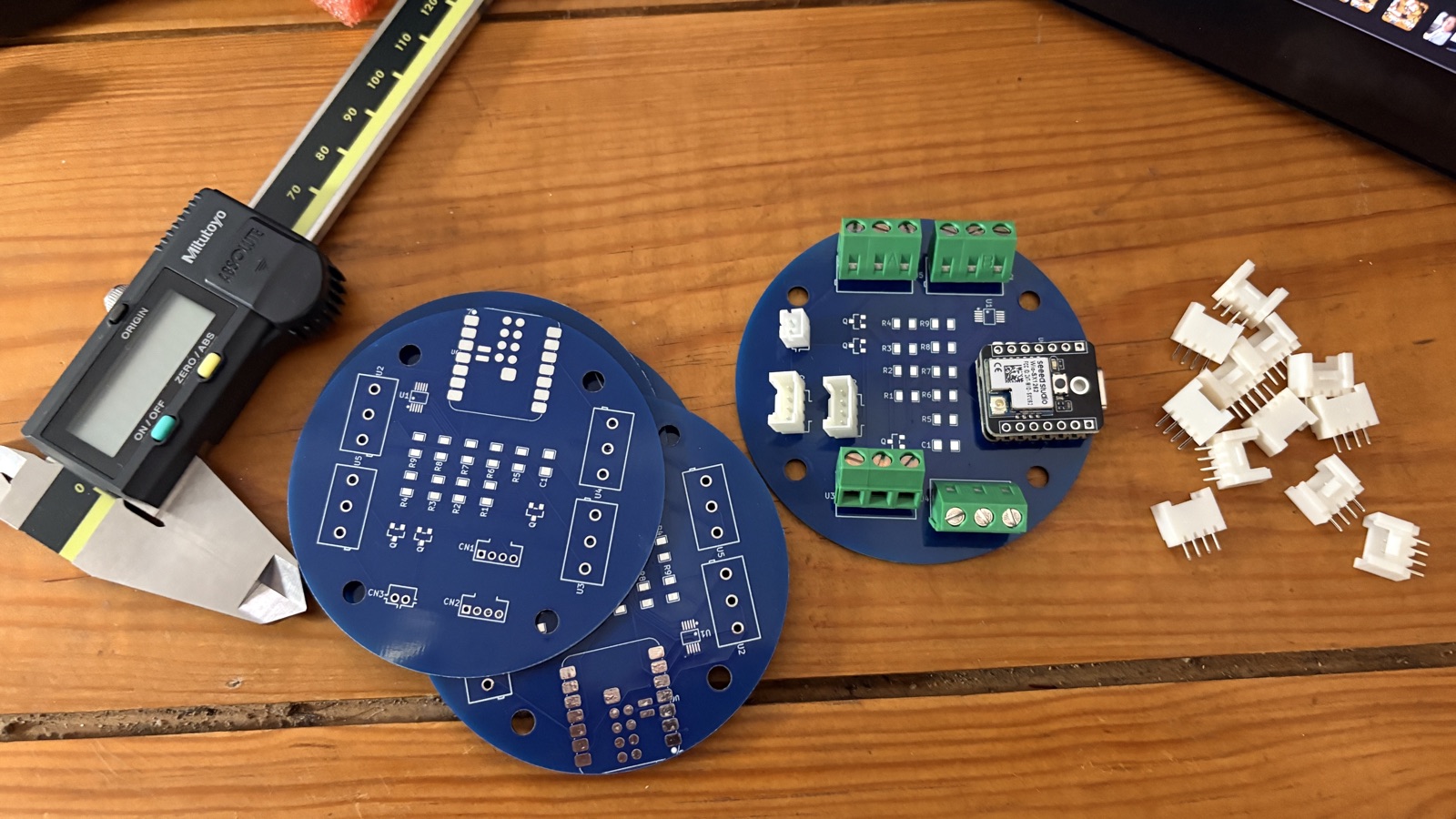
WellBouy is the V3 GROUU node for water — a deployed, battery-powered LoRaWAN sensor that measures temperature, dissolved solids, turbidity and pH at a source and streams to a live dashboard. Firmware and the data pipeline are complete and running; the dedicated board is fabricated. It is one node in a wider, shared system.
WellBouy feeds the shared GROUU server stack; the same infrastructure serves gardens, greenhouses and wells.
← downlink: Node-RED → TTN queue → node RX window · 0x01 set interval · 0x02 reboot — applied next wake (Class A).
Architecture & enclosure
How the system is shaped: the radio-per-context architecture it belongs to, and the board + enclosure modelled in Fusion.
Modular nodes choose their radio by context: Wi-Fi where a network exists, LoRaWAN where it doesn't. Both land in the same server stack — the 2014 vision (V0), finally modular.
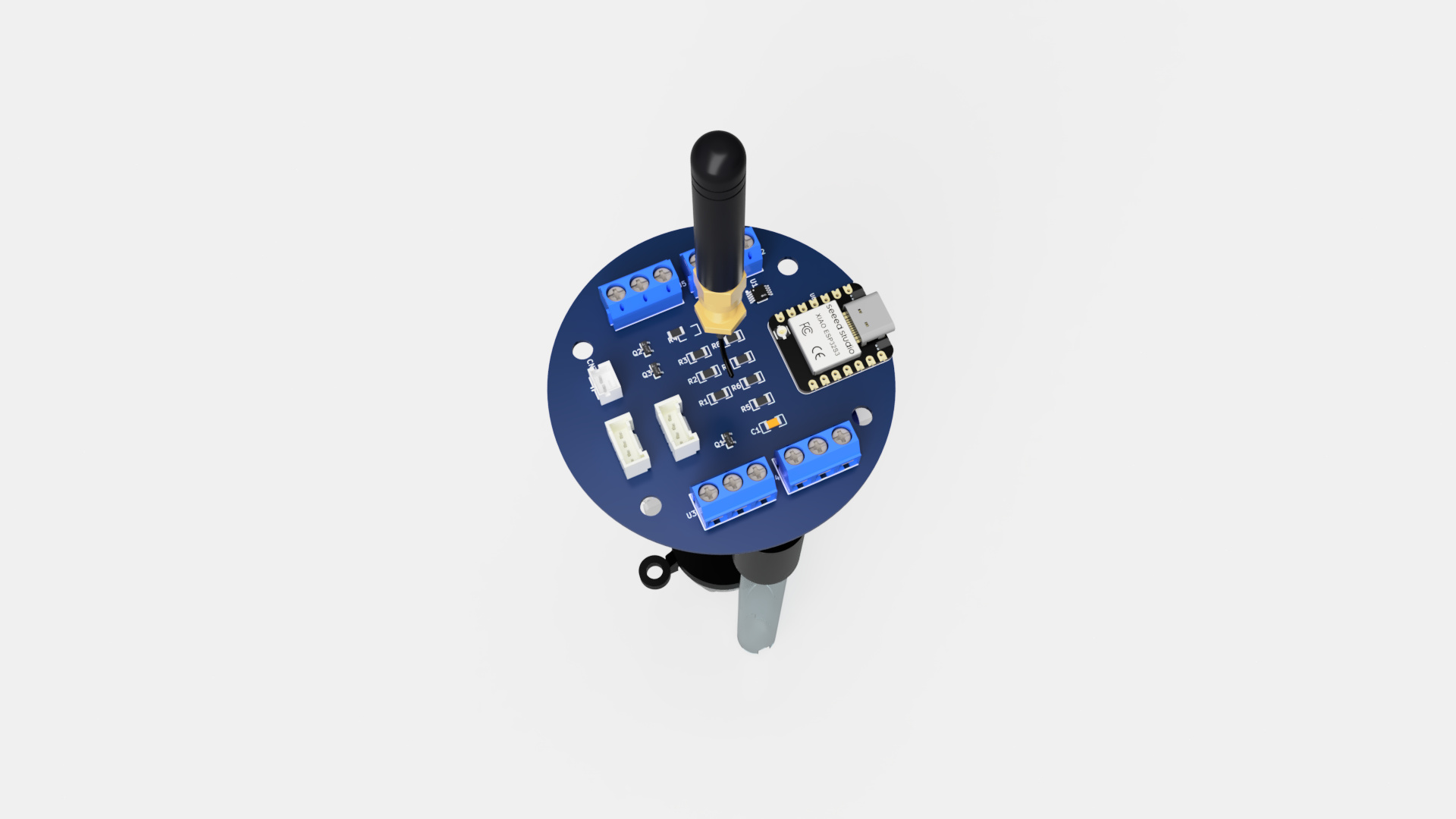
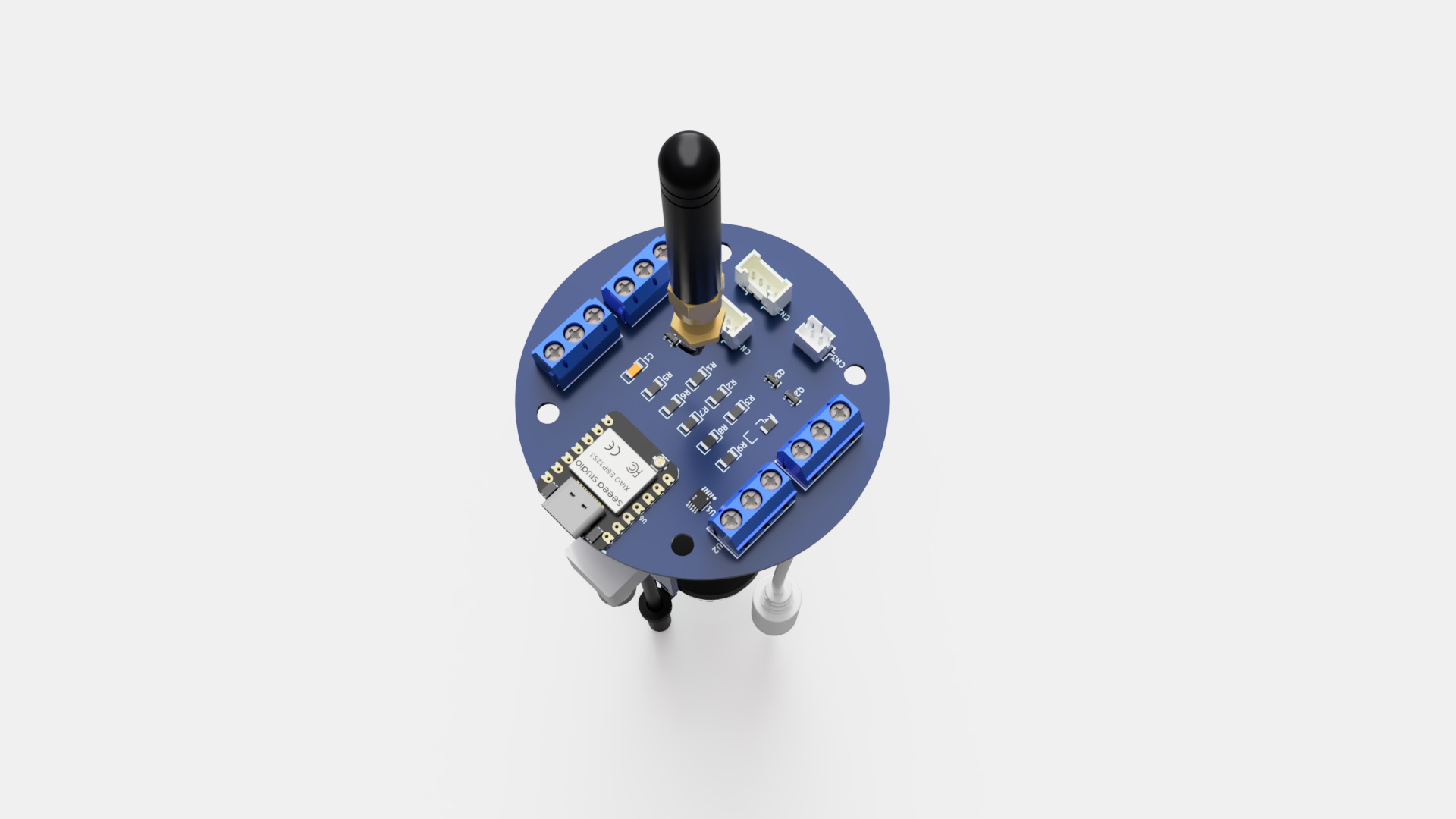
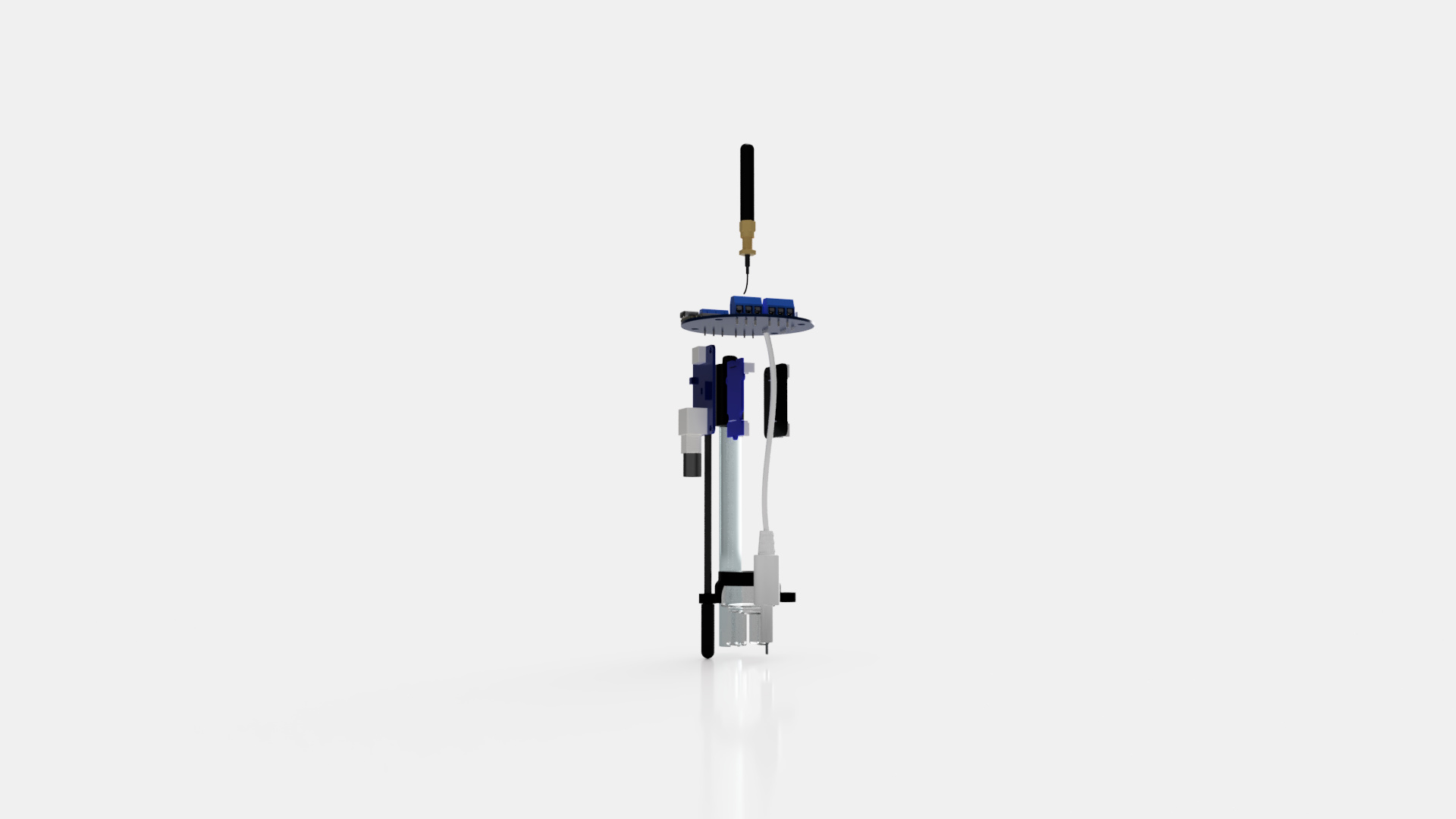
The board and enclosure are modelled in Autodesk Fusion; the viewer always shows the latest version. Component layout and sketching studies are in the gallery below.
Sensors, front-end, power
All modules are off-the-shelf, so the design is reproducible without custom silicon. Every driver is written and calibrated.
Waterproof digital probe on OneWire, 4.7 kΩ pull-up, 3.3 V. Clean °C to serial and uplink.
Analog Grove TDS on the switched 5 V rail, output into the ADS (A0). DFRobot Gravity two-point k-value algorithm, temp-compensated ppm.
Optical head, cabled; a 10k / 6.8k divider brings the 5 V output into ADC range (A1). Reported as a clear-anchored relative index (0 = clear); absolute NTU pending a formazin standard.
GigaΩ analog conditioner (pH 7 ≈ 2.5 V) through a 10k / 18k divider into the ADS (A2); three-point calibration (pH 4 / 7 / 10, segmented at pH 7).
Always-on — MCU, radio, ADS1115 and the DS18B20.
Switched — analog conditioners powered ~1 s per cycle through a high-side load switch (GPIO1 / D0).
1S LiPo (4500 mAh), mains-rechargeable — a fixed well site needs no panel. The board still exposes battery + solar inputs, so the same design runs off-grid elsewhere.
| Part | Role | Source |
|---|---|---|
| Seeed XIAO ESP32-S3 + Wio-SX1262 | MCU + LoRa radio (SX1262 via RadioLib) | Seeed ↗ |
| ADS1115 | Shared 16-bit I²C ADC @ 0x48 — analog sensors on A0–A2 | — |
| DS18B20 (waterproof) | Water temperature — 1-Wire (GPIO4) + 4.7k pull-up | Adafruit ↗in stock |
| Seeed Grove TDS | Dissolved solids (A0) — DFRobot Gravity algorithm, temp-compensated | Seeed ↗in stock |
| Seeed Grove turbidity | Turbidity (A1) via 10k/6.8k divider, 5 V — clear-anchored relative index | Seeed ↗in stock |
| Phidgets ASP200 pH probe | pH 0–14, gel-filled BNC probe | Phidgets ↗in stock |
| Phidgets 1130 pH/ORP adapter | BNC → analog (A2) via 10k/18k divider, 5 V | Phidgets ↗in stock |
| Grove Shield for XIAO | Bring-up carrier; final build uses the fabricated well-bouy01 board | Seeed ↗to order |
| LiPo 1S 4500 mAh | Battery — mains-rechargeable, no solar (B1) | Mauser ↗to order |
| Dividers 10k/6.8k · 10k/18k | Level-shift turbidity & pH into ADC range | — |
| M12 glands · BNC bulkhead · O-rings | Hull pass-throughs & seal | to order |
| pH buffers 4 / 7 / 10 · TDS KCl 84 / 1413 µS/cm | pH three-point + TDS two-point calibration standards | to order |
Firmware & interface
One PlatformIO project — staged bring-up sketches plus the integrated production firmware — and the dashboard that renders it.
Wake, measure, transmit, sleep — as implemented in src/main.cpp: sensors are read and powered down before the radio wakes.
Procedural C++ (PlatformIO), one cycle per wake: main.cpp orchestrates the duty cycle, each sensor is a small two-function module, every field-tunable constant lives in config.h.
src/main.cpp — CayenneLPP encode + uplink (TDS & turbidity ride the Luminosity type, 0–65535, because Analog Input overflows above 327.67)
CayenneLPP lpp(51);
lpp.reset();
lpp.addTemperature(1, isnan(r.temperatureC) ? 0.0f : r.temperatureC);
lpp.addAnalogInput(2, r.ph);
lpp.addLuminosity (3, (uint16_t)(r.turbidityIdx + 0.5f));   // turbidity (relative index)
lpp.addLuminosity (4, (uint16_t)(r.tdsPpm + 0.5f));         // TDS
if (bootCount == 1 || (bootCount % 24) == 0)
  lpp.addGPS(5, FIXED_LATITUDE, FIXED_LONGITUDE, FIXED_ALTITUDE);

int16_t state = node.sendReceive(lpp.getBuffer(), lpp.getSize(),
                                 LPP_FPORT, dnData, &dnLen, /*confirmed=*/false);
InfluxDB feeds both the internal Grafana boards and the public page.
Values illustrative. Live: temp · TDS · turbidity · pH · RSSI/SNR — battery + packet-loss pending.
Done, how, and what's left
The firmware is organised so anyone can rebuild it incrementally — flash one stage, confirm it on serial and TTN, move on. Register your own device on TTN (EU868, LoRaWAN 1.0.x, OTAA), set the payload formatter to CayenneLPP, and keep your keys in an untracked secrets.h.
Renders, sketching & bench